
Media
News Archive
Year
Dollar store makeup, laundry detergent and skincare products list chemicals linked to health harms, highlights new product screening
September 28, 2026
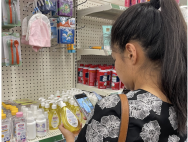
New product screening data from the Campaign for Healthier Solutions highlights dollar store personal care and household products that openly list ingredients linked to health harms, including endocrine disruption, reproductive harm, and cancer. Six out of 78 products screened listed chemicals that are prohibited in cosmetics in at least one U.S. state, now or starting in 2027, including PFAS, formaldehyde releasers, toluene and lilial. “Dollar stores need to get ahead on compliance,” said José Bravo, National Coordinator of the Campaign for Healthier Solutions. “Our product screening initiative shows it’s not that hard to find a banned ingredient openly listed on product labels in the dollar store beauty aisle.” California bans intentionally-added PFAS in cosmetic products, which include products applied to the human body for cleansing and beautifying. A “Bling Bubbles Razz-Fizz Scented Purify & Detoxify Bubbling Face Mask” sold at a Dollar Tree in Coachella, California in July 2026 listed “methyl perfluoroisobutyl ether” in its ingredients, which is a PFAS chemical according to California law.
Read MoreUn nuevo análisis de productos revela que el maquillaje, el detergente para ropa y los productos para el cuidado de la piel vendidos en tiendas de bajo costo contienen sustancias químicas relacionadas con riesgos para la salud.
September 28, 2026
Datos de análisis de nuevos productos, procedentes de la organización Campaign for Healthier Solutions, señalan productos de cuidado personal y del hogar vendidos en tiendas de bajo costo que indican abiertamente contener ingredientes asociados a riesgos para la salud, tales como alteraciones endocrinas, daños reproductivos y cáncer. Seis de los 78 productos analizados contenían sustancias químicas prohibidas en cosméticos en al menos un estado de EE. UU. ya sea actualmente o a partir de 2027, entre ellas PFAS, liberadores de formaldehído, tolueno y lilial. “Las tiendas de dólar deben adelantarse en materia de cumplimiento”, afirmó José Bravo, coordinador nacional de la Campaña por Soluciones más Saludables (Campaign for Healthier Solutions). “Nuestra iniciativa de análisis de productos demuestra que no es difícil encontrar un ingrediente prohibido que aparece abiertamente en las etiquetas de los productos de la sección de belleza de estas tiendas.”
Read More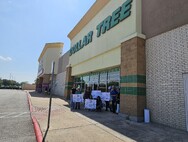
Dollar Tree expands chemical safety policy with new restrictions and greater supplier transparency
August 17, 2026
This year, Dollar Tree published an expanded Chemical Management Policy that commits to restrict more harmful chemicals in key private-label product categories, including food packaging, children’s products, and formulated products such as beauty, personal care and household cleaning products. “We applaud Dollar Tree’s efforts to eliminate chemicals linked to endocrine disruption, learning disabilities, cancer and reproductive harm from its shelves,” said José Bravo, Coordinator of the Campaign for Healthier Solutions. “Families deserve safe products and healthy food no matter where they shop.”
Read More
Back-to-Back Chemical Disasters Strike as Trump Seeks to Roll Back Safety Rules
May 31, 2026
Two major incidents at chemical plants within the past week sent tens of thousands fleeing from their homes in California and left 11 people dead in Washington. But despite a spate of similar incidents over the last year, the Trump Administration is planning to roll back federal regulations designed to prevent similar disasters. Experts and environmental groups have warned that such a move would make chemical accidents far more common. According to the Coalition to Prevent Chemical Disasters—a group of environmental justice, labor, public health, national security, and environmental organizations—at least 215 dangerous chemical incidents occurred in 2025, including fires, explosions, and toxic releases. It says there have been at least 1,446 hazardous chemical incidents in the U.S. since 2021, an average of 5 incidents per week.
Tragic deaths in Washington, massive evacuation in California show Trump Environmental Protection Agency is failing to keep Americans safe from chemical disasters
May 29, 2026
“The fatal and shocking incidents communities have faced in recent days demonstrate the urgent need to implement and build on existing regulatory safeguards so communities near chemical facilities are protected from chemical disasters. But, instead of protecting workers and families from death, injury, and illness, Trump’s EPA is putting communities at greater risk of harm by weakening the nation’s primary defense against chemical facility incidents. The Risk Management Program (RMP) protects against catastrophic industrial chemical releases, fires, and explosions through preventative safety measures. The Trump administration is attempting to weaken this rule. Every chemical incident, every life lost, and every evacuation is one too many. Each chemical emergency makes clear the need to strengthen, not dismantle, protections against chemical disasters before more workers, families, and communities are harmed.”
Read More
The Trump administration is deleting government data. From infant deaths to hunger, here are 5 ways it’s hurting Americans
May 7, 2026
Until last year, one of the best ways to find out if you live near one of the roughly 12,000 facilities that store hazardous, cancer-causing chemicals used in manufacturing products like pesticides or medical devices was to go to an EPA webpage for the Risk Management Program (RMP). There you could type in your zip code in a search tool, and see if any of these chemical factories are nearby. (Latino, Black and low-income people are more likely to bear the brunt of chemical pollution; they disproportionately live closer to chemical plants than other groups.) But last April, the Trump administration took down this tool. Now the only way to get this information is to drive to one of several dozen EPA reading rooms across the country to examine paper records. “You have a right to know what’s in your back yard,” said Maya Nye, federal policy director for Coming Clean, a non-profit environmental health collaborative. She said the removal of the tool is particularly concerning because “we haven’t figured out how to prevent chemical disasters and people are still experiencing them”.
Read More
Chemical Threats Nearby? Trump’s EPA Doesn’t Want You to Know.
April 14, 2026
Climate change is making the risk of disastrous chemical accidents more likely. But the EPA wants to gut recently enhanced safety requirements for hazardous facilities. Raschelle Grandison had just walked out her front door to grab something from her car on a chilly March morning in 2019 when she stopped dead in her tracks. Grandison stared in disbelief at what looked like a nuclear mushroom cloud approaching the Houston home she shared with her mother, who ran outside to see what was wrong. They were still watching the giant black cloud hurtling toward their neighborhood from the Houston Ship Channel when the shelter-in-place alerts started blaring. A massive fire had started at a bulk-liquid storage facility run by the Intercontinental Terminals Co. about 5 miles away after a faulty pump released naphtha, a highly flammable hydrocarbon used to make gasoline and plastic, from an 80,000-barrel tank.
Read More
Proposed EPA rollbacks would put communities at greater risk for chemical disasters, workers and advocates warn
March 27, 2026
Workers, lawmakers and environmental advocates gathered this week to speak out against a proposed federal rule that would roll back protections for people who live near hazardous facilities across the country. “This is just the latest example of how this administration will do whatever it can to put industry profit over the health and safety of workers, first responders and communities that allow those companies to exist in the first place,” US Rep. Paul Tonko, a Democrat from New York, said during a March 25 press event on Capitol Hill in Washington, DC. The event was organized by the Coalition to Prevent Chemical Disasters, an alliance of community, environmental, and labor organizations working to strengthen federal regulations to prevent chemical disasters.
Read More
Chemical Plants Keep Exploding, but Trump’s EPA Is Rolling Back Safety Rules Anyway
March 5, 2026
In 2024, the federal Environmental Protection Agency attempted to address the risk of chemical leaks through a rule called the Safer Communities by Chemical Accident Prevention. It promised a modest course correction, requiring dangerous plants to investigate past accidents, plan for climate-fueled disasters, give workers more power to halt unsafe operations, and, in some cases, switch to safer chemicals or processes. But last month, Trump’s EPA proposed gutting most of those safeguards before they ever took effect, moving to strip away requirements for safer technologies, climate and natural disaster planning, third-party safety audits, and strong worker participation in decision making. “For fenceline communities and facility workers, this rollback is a declaration that our lives are deemed acceptable sacrifices,” said Ana Parras, executive director of Texas Environmental Justice Advocacy Services, a group that has worked in several national coalitions around chemical safety.
Read More
“Disaster Déjà Vu” shows the cost of gutting protections from the nation’s most hazardous facilities
February 24, 2026
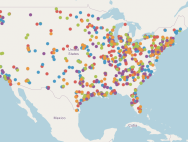
A new analysis and interactive map illustrates the real-world impacts of gutting regulations for the nation’s most hazardous chemical facilities, as recently proposed by the Trump Administration’s Environmental Protection Agency (EPA). Disaster Déjà Vu outlines six Texas facilities with recent histories of back-to-back chemical incidents – including fires, explosions, and worker injuries – that are regulated by the EPA’s Risk Management Program (RMP). New requirements for RMP facilities, intended to make communities safer from the threat of chemical disasters, were finalized under the Biden Administration and were slated to begin going into effect this year, until President Trump’s EPA proposed rollbacks. These rollbacks are “a capitulation to industry demands, at the expense of public safety,” concludes the analysis, co-authored by Coming Clean, the Environmental Justice Health Alliance for Chemical Policy Reform (EJHA), and Texas Environmental Justice Advocacy Services (T.e.j.a.s.).
Read More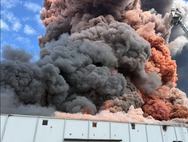
Trump’s EPA proposes gutting chemical disaster protections, threatening community health and safety
February 19, 2026
The U.S. Environmental Protection Agency (EPA) has proposed weaker regulations for the nation’s most hazardous chemical facilities, drawing opposition from community, environmental justice, labor and environmental health groups. “This rollback will cost lives,” said Michele Roberts, National Coordinator of the Environmental Justice Health Alliance for Chemical Policy Reform. “EJHA affiliates refuse to continue to sacrifice their families’ health and safety for the profits of corporate polluters.”
Read More